Urban Choices Knowledge Strategy
Industry Expertise as the Source of Intelligence
1. Core Principle
Urban Choices is not attempting to “replace” industry experts with AI.
Instead, the platform is designed to capture, preserve, and scale real-world expertise from professionals who have deep, practical knowledge in specific industries and applications.
The intelligence of Urban Choices—and AskBrian in particular—is built directly from these expert engagements.
2. Who the Experts Are
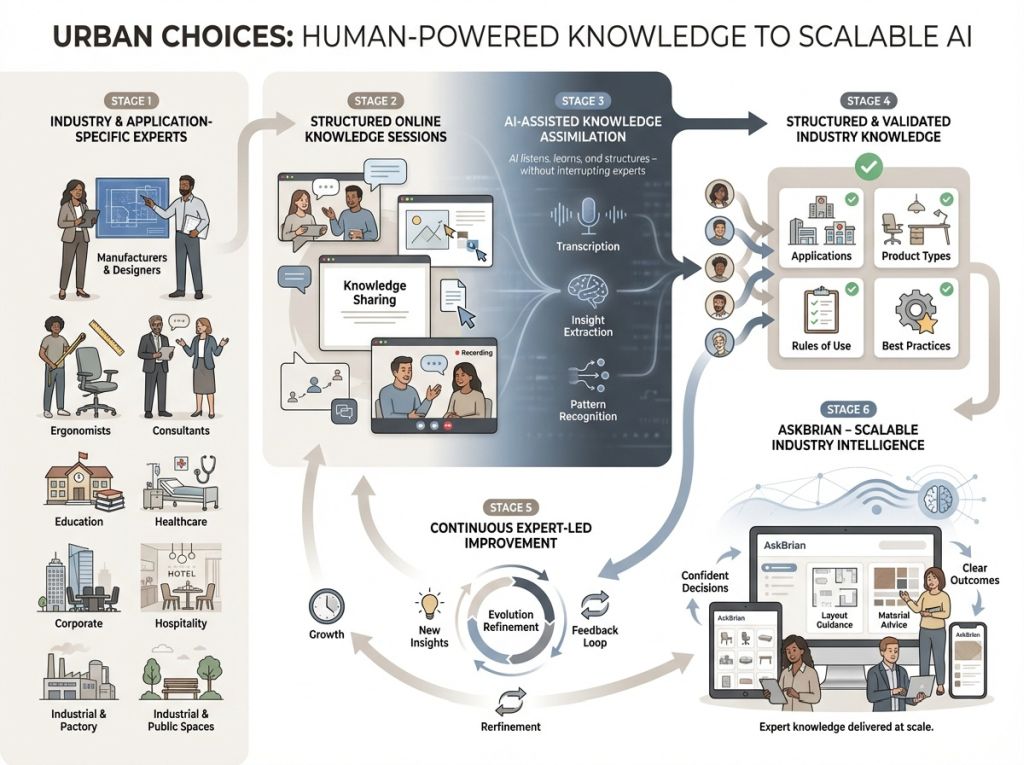
Urban Choices actively engages with:
Furniture manufacturers
Designers and specifiers
Ergonomics specialists
Fit-out professionals
Industry consultants
Application specialists (education, healthcare, corporate, hospitality, industrial, public spaces)
Each expert contributes application-specific insight, not generic theory.
3. How Expert Engagements Take Place
Structured Online Sessions
Knowledge is captured through online meetings (e.g. Zoom / Teams).
Sessions are conversational, guided, and practical—not technical.
Experts simply explain:
How decisions are made
Why certain products work in specific environments
Common mistakes to avoid
Trade-offs between cost, durability, ergonomics, and aesthetics
No preparation beyond normal professional discussion is required.
4. AI’s Role – Silent Knowledge Assimilation
During these online engagements, AI works quietly in the background:
Conversation Transcription:
AI converts spoken discussions into structured text.Insight Extraction:
Key points such as:Decision logic
Rules of thumb
Preferences and constraints
Application-specific recommendations
are automatically identified.
Knowledge Structuring:
The AI organises the information into:Applications (e.g. classrooms, call centres, laboratories)
Product types and attributes
Use-case rules and guidance
Do’s and don’ts learned from experience
Experts do not interact with the AI directly—the system adapts around them.
5. From Conversation to Intelligence
After each engagement:
Raw insights are reviewed and validated.
Duplicate or conflicting inputs from multiple experts are resolved.
Consensus patterns emerge across industries and applications.
These patterns become reliable, reusable knowledge inside AskBrian.
This ensures that AskBrian reflects collective industry wisdom, not a single opinion.
6. Continuous Learning Model
Urban Choices is not a once-off training exercise.
Every new expert engagement:
Refines existing knowledge
Adds new application layers
Updates recommendations as markets evolve
AskBrian improves through:
Ongoing expert input
Real-world feedback from users
Continuous validation against industry standards
This makes the platform future-proof and adaptive.

Product & Visual Data Management
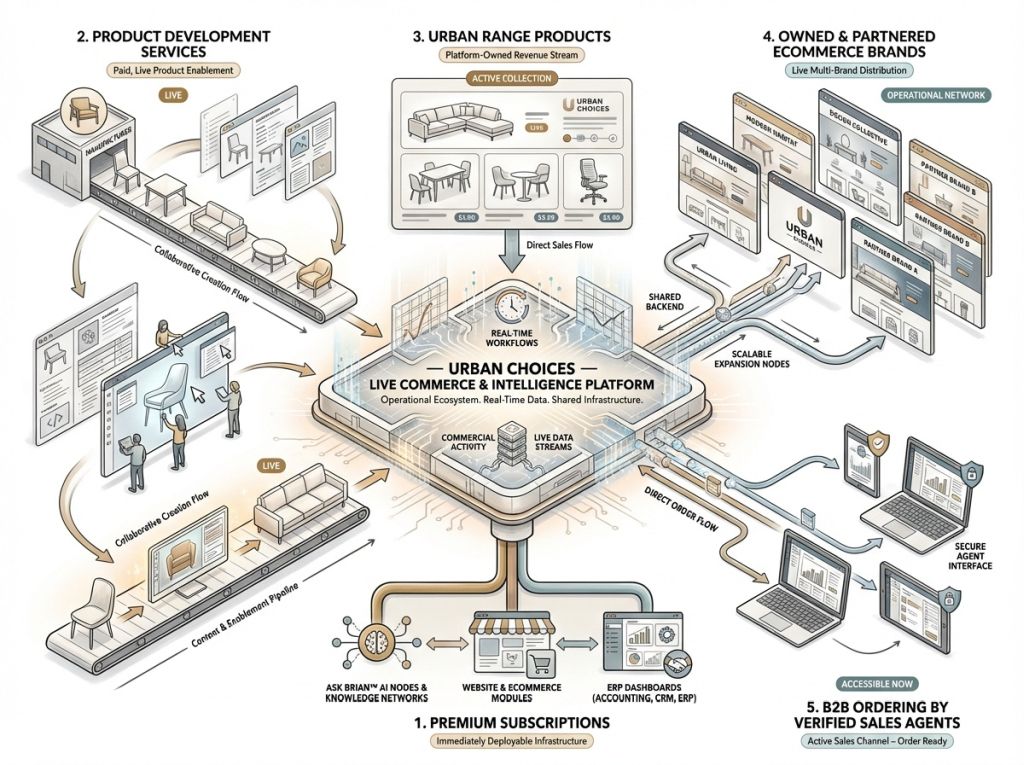
Urban Choices is not simply aggregating furniture products; it is building a category-defining product intelligence and visual asset platform that sits between manufacturers and sales agents.
In this model, product imagery is not marketing collateral—it is a core system asset that enables trust, consistency, speed-to-market, and scalable representation across multiple sales channels.
To succeed, Urban Choices must treat product data and imagery as enterprise-grade assets, governed to an enterprise standard equivalent to financial and ERP data management.
1. Single Source of Truth (SSOT)
Urban Choices will establish a centralised Product & Asset Master, serving as the authoritative reference for:
Product identity (SKU logic, families, ranges)
Technical attributes (dimensions, materials, certifications)
Configurable options and variants
Visual models (imagery, renders, scene compositions)
Principle:
No product or image exists “in the ecosystem” unless it is registered, versioned, and approved within the Urban Choices master framework.
This prevents:
Image drift between manufacturers and agents
Inconsistent representations of the same product
Duplication of effort and rework.
2. Structured Product Data Model (PDM-first)
Urban Choices will develop a PDM-led structure (Product Data Management), not a marketing-led one.
Key characteristics:
Attribute-driven (not description-driven)
Variant-aware (bases, fabrics, finishes, sizes)
Industry-aligned (contract furniture standards, certifications)
Machine-readable and AI-ready
This allows:
Automated image generation and validation
Consistent storytelling across brands
Scalable onboarding of new manufacturers
3. Image as Data, Not Decoration
All product imagery will be treated as structured data assets, each linked to:
A specific product model
A defined configuration state
A usage intent (catalogue, lifestyle, technical, sales enablement)
Images are referenced, not duplicated, across:
Urban Choices platform
Manufacturer microsites
Sales agent toolkits
Brochures and digital campaigns
Workflow: Controlled, Collaborative, Scalable
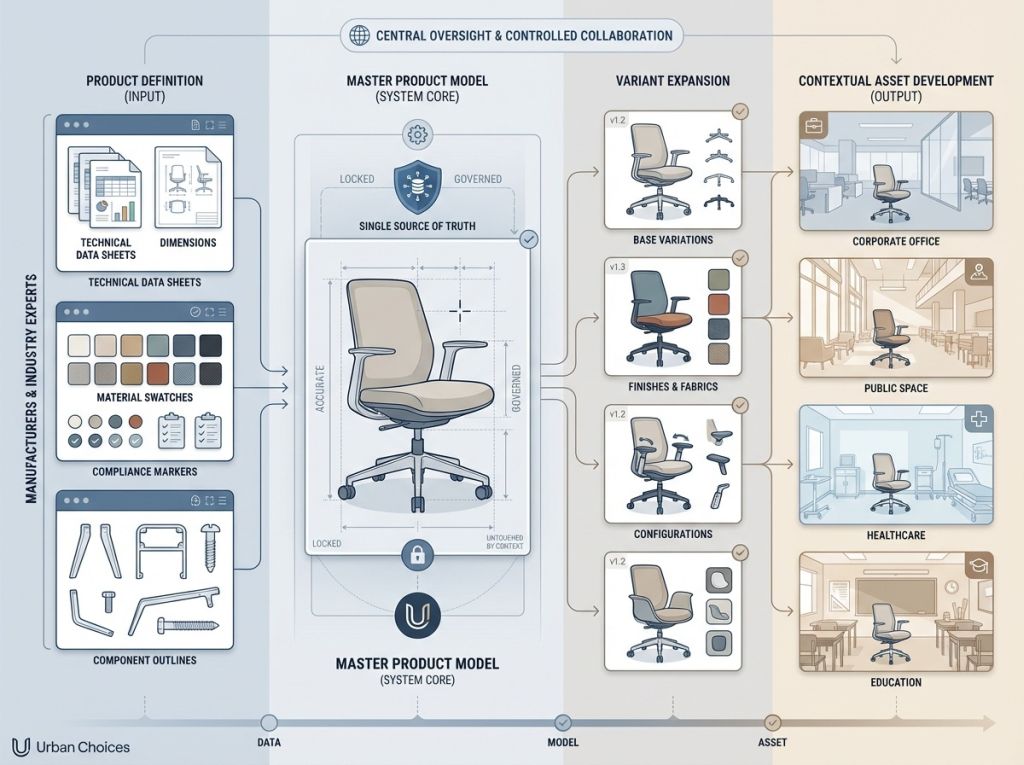
1. Model-Centric Development Workflow
Urban Choices will work from a “Product Model” concept, not from ad-hoc images.
Each product progresses through defined stages:
Stage 1 – Product Definition
- Manufacturer provides verified technical data
- Urban Choices structures attributes and variants
- Industry experts validate ergonomics, compliance, and positioning
Stage 2 – Base Product Model Creation
- A definitive visual reference is established
- Geometry, proportions, and materials are locked
- This becomes the visual “master”
Stage 3 – Variant Expansion
- Bases, finishes, fabrics, and accessories are applied systematically
- Variants inherit from the base model (not recreated manually)
Stage 4 – Scene & Contextual Asset Development
- Corporate, public, healthcare, education, or industrial contexts
- Lifestyle vs. technical vs. sales-driven imagery
- All scenes reference the same underlying model
2. Role Clarity & Governance
Urban Choices acts as the orchestrator, not the bottleneck.
| Role | Responsibility |
|---|---|
| Manufacturer | Product truth, technical accuracy |
| Industry Experts | Validation, compliance, use-case alignment |
| Urban Choices | Data structure, standards, governance |
| Creative / AI Systems | Asset generation within constraints |
| Sales Agents | Consumption, not creation |
Key governance rule:
Sales agents never modify core product imagery—only select from approved assets.
3. Approval & Version Control
Every asset follows:
- Defined approval gates
- Versioning (v1.0, v1.1, v2.0)
- Change logs linked to product updates
This ensures:
- Historical traceability
- Confidence when products evolve
- Legal and commercial defensibility
C. Asset Development: Building Long-Term Platform Value
1. Modular Asset Strategy
Urban Choices will build modular visual assets, not one-off images:
- Base product model
- Interchangeable components (bases, arms, fabrics)
- Reusable environments
- Overlay layers (branding, annotations, data callouts)
This dramatically reduces:
- Cost per new asset
- Time-to-market for new products
- Dependency on continuous re-shoots or redesigns
2. AI-Enabled, Human-Governed
AI will be used as an accelerator, not a decision-maker.
AI applications:
- Variant generation from approved base models
- Scene placement within defined environments
- Lighting, perspective, and consistency enforcement
Human oversight ensures:
- Brand integrity
- Manufacturing realism
- Industry credibility
3. Asset Lifecycle Thinking
Every asset is designed with a multi-year lifespan:
- Initial onboarding
- Sales enablement
- Specification support
- Marketing reuse
- Archive and replacement
Assets are retired deliberately, not abandoned.